| Article found | Fact |
|---|
|
Security for Parlay-X - challenges and solutions [Eckardt]
|
WS-Security toolkits:
-
Security implemented as part of the application
- implementation (coding) needed in every single end-system
- toolkits available for some security functionality
- resource-intensive (CPU cycles) processing needed at Parlay-X Gateway
- severe impact on service-handling capacity of Parlay-X Gateway
- denial-of-service by heavy loads of requests for execution of security
mechanisms (authentication, encryption, dig. signature)
- WS-Security standardization cycles and application release cycles must be
coordinated
-
Drawbacks
- security and application code mixed
- security integration may involve modifying source code
- potential vendor dependencies (APIs, mgt. of security etc.)
- security management involves multiple hosts and pieces of software
- WS-Security processing is extremely hungry for CPU cycles!
WS-Security Gateways:
-
SOAP Security Proxy
- provides a virtual service endpoint (hides URL of Parlay-X Gateway)
- messages sent to the security proxy,
- inspected there ("content inspection"),
- content filtering, parameter filtering, SLA enforcement
- (if approved by the content inspection) forwarded to the Parlay-X Gateway
- rule-based selection of specific Parlay-X GW (load-balancing, SLA, security)
- -> SOAP Firewall
-
Application-level security (3-4A) gateway
- CPU-intensive processing offloaded to highly specialized system:
-
authentication (at the perimeter)
-
authorization
-
confidentiality (selective encryption/decryption)
-
integrity (selective XML digital signatures)
-
audit
- centralized administration (of security policies, audit trails, OAM)
-
Advantages of SOAP Security Proxies
- provide very comprehensive set of WS-Security standards
- emerging security standards tightly tracked and timely implemented
- transparent integration with heterogeneous portfolio of Parlay-X
applications and other telco Web Services
- with planned systems
- into existing systems in production environments! (no coding!)
- complete separation of application form security functions
- CPU-intensive processing offloaded to proxies
- often built to enterprise-grade requirements
- performance, scalability
- manageability
- centralized control via remote policy server
- high availability/ failover support
|
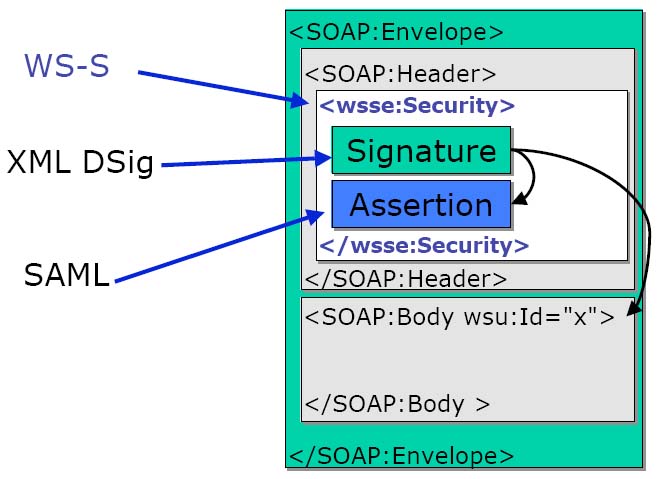
 WS-Security has emerged as the de facto method of inserting security data into SOAP messages [On02]
 work began in 2001 [On02]