| Article found | Fact |
|---|
|
Secure, Reliable, Transacted Web Services [FS03]
|
- high-level grouping of the Web service specifications (this figure is not meant to imply a strict layering between the groups; instead it is intended to provide an intuition about the relationships between functional areas. For example, message security does not require Description and similarly Description is a useful development time concept for Messaging.):
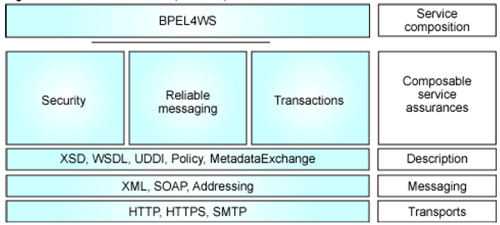
this figure is not meant to imply a strict layering between the groups; instead it is intended to provide an intuition about the relationships between functional areas. For example, message security does not require Description and similarly
Description is a useful development time concept for Messaging.
- the Web service model does not operate on the notion of shared types that require common
implementation. Rather, services interact based solely on contracts (WSDL/BPEL4WS for message processing behavior) and
schemas (WSDL/XSD for message structure). This enables the service to describe the structure of messages it can send and/
or receive and sequencing constraints on these messages. The separation between structure and behavior and the explicit,
machine verifiable description of these characteristics simplifies integration in heterogeneous environments.
|
|
XML / SOAP Web Services Security [Mü02]
|
- Web Services sind Softwarekomponenten, die über Beschreibungsstandards und
Standardprotokolle im Internet zugänglich sind.
- XML Web Services nutzen XML als Beschreibungssprache und HTTP als Übertragungsprotokoll.
charakterisiert durch:
- dezentrale Architektur und Administration
- heterogene Implementierungen und Systeme
- unternehmensübergreifende Kommunikation und Verbindungen
- öffentlicher Zugang über das Internet
|
|
Security for Parlay-X - challenges and solutions [Eckardt]
|
- modular, extensible, service-oriented interfaces
- ASCII-based transfer syntax
- Loose coupling
- SOAP appropriate for inter-application communications:
-
asynchronous vs synchronous
- few, coarse-grained (service-oriented) interfaces vs many fine-
grained objectoriented) interfaces
-
extensible specifications vs tightly-coupled implementation dependence
- Document-based exchange patterns
- self-contained messages w/o connection-based context!
-
per-message security context vs per-connection security context
- -> SSL is of limited use only! (XML Encryption, XML Signature more applicable)
|
