| | | | Contents: | | |
| | Related content: | | |
| | Subscriptions: | | |
|
Untangling the business Web of the future
David Mertz, Ph.D. (mertz@gnosis.cx)
Phenomenological unifier, Gnosis Software, Inc.
01 Jun 2001 ebXML
is a big project with a lot of pieces. In this article David Mertz
outlines how the pieces all fit together. This overview provides an
introduction to the ebXML concept and then looks a bit more
specifically at the representation of business processes, an important
starting point for ebXML implementations. Two short bits of sample code
demonstrate the ProcessSpecification DTD and a package of
collaborations. When you read about ebXML, it's
difficult to get a handle on exactly what it is -- and on what it
isn't. The 'eb' in ebXML stands for "electronic business," and you can
pronounce the phrase as "electronic business XML," "e-biz XML,"
"e-business XML," or simply "ee-bee-ex-em-el." What is ebXML?
On one hand, ebXML seems to promise a grand unification of everything
businesses do to communicate with each other. On the other hand, one
could be forgiven for thinking that ebXML amounts to little more than a
pious, but vacuous, declaration that existing standards are worth
following. As with every "next big thing," the truth lies somewhere in
the middle. ebXML terminology
Registry:
A central server that stores a variety of data necessary to make ebXML
work. Amongst the information a Registry makes available in XML form
are: Business Process & Information Meta Models, Core Library,
Collaboration Protocol Profiles, and Business Library. Basically, when
a business wants to start an ebXML relationship with another business,
it queries a Registry in order to locate a suitable partner and to find
information about requirements for dealing with that partner.
Business Processes:
Activities that a business can engage in (and for which it would
generally want one or more partners). A Business Process is formally
described by the Business Process Specification Schema (a W3C XML
Schema and also a DTD), but may also be modeled in UML. Collaboration Protocol Profile (CPP):
A profile filed with a Registry by a business wishing to engage in
ebXML transactions. The CPP will specify some Business Processes of the
business, as well as some Business Service Interfaces it supports. Business Service Interface:
The ways that a business is able to carry out the transactions
necessary in its Business Processes. The Business Service Interface
also includes the kinds of Business Messages the business supports and
the protocols over which these messages might travel. Business Messages:
The actual information communicated as part of a business transaction.
A message will contain multiple layers. At the outside layer, an actual
communication protocol must be used (such as HTTP or SMTP). SOAP is an
ebXML recommendation as an envelope for a message "payload." Other
layers may deal with encryption or authentication. Core Library:
A set of standard "parts" that may be used in larger ebXML elements.
For example, Core Processes may be referenced by Business Processes.
The Core Library is contributed by the ebXML initiative itself, while
larger elements may be contributed by specific industries or businesses. Collaboration Protocol Agreement (CPA):
In essence, a contract between two or more businesses that can be
derived automatically from the CPPs of the respective companies. If a
CPP says "I can do X," a CPA says "We will do X together." Simple Object Access Protocol (SOAP):
A W3C protocol for exchange of information in a distributed environment
endorsed by the ebXML initiative. Of interest for ebXML is SOAP's
function as an envelope that defines a framework for describing what is
in a message and how to process it. |
The ebXML.org homepage offers this brief characterization: ebXML
is a set of specifications that together enable a modular electronic
business framework. The vision of ebXML is to enable a global
electronic marketplace where enterprises of any size and in any
geographical location can meet and conduct business with each other
through the exchange of XML-based messages.
Or in other words, ebXML hopes to succeed Electronic
Data Interchange, more often known by its abbreviation, EDI. (Official
descriptions tend to emphasize learning from EDI rather than throwing
it out.) ebXML terminology
Sorting out ebXML involves a few steps. Perhaps the first thing
necessary for understanding the details of ebXML is to digest an
alphabet soup of new acronyms and other special terms. There are a
number of these terms in the sidebar to the right (
ebXML terminology)
to consider before looking at the whole "vision" of ebXML interactions.
Additional terms fit into the entire system, but these particular terms
make a good starting point. With this new vocabulary in mind, and a bit
of the following background on where ebXML comes from, you can begin to
make sense of how all of the differing processes in ebXML hold together. After
describing what ebXML does (at least in outline) at the beginning of
this article, a final section looks in more detail at the Business
Process Specification Schema, which makes up one of the most important
elements of ebXML's underlying infrastructure. Background
ebXML is an initiative whose participants and endorsers consist of just
about every big company and association of government standards
worldwide that you can think of. Well, maybe not every one you can think of, but certainly hundreds of large companies and bodies. Computer/technology
companies are not the only entities that endorse ebXML; backers include
a large number of industrial, shipping, banking, and other
general-interest companies. The direct sponsors of ebXML are OASIS
(Organization for the Advancement of Structured Information Standards)
and UN/CEFACT (United Nations Centre for Trade Facilitation and
Electronic Business). Lots of standards bodies also have a finger in
the pie, including NIST (National Institute of Standards and
Technology) and W3C (World Wide Web Consortium). With such a
collection of supporters, it would seem that ebXML is destined to take
over the world. I tend to have a cynical attitude toward industry
buzzwords and hype. In the case of ebXML, however, I mostly expect it
to live up to its billing as a global protocol for most business
transactions within the next five years. In my opinion, ebXML
will succeed in becoming universal by incorporating into the
specifications more and more of what businesses do anyway as much as it will by actually getting businesses to do business differently.
I'm not sure if my estimation is cynical or if it is encouragement at
the openness of ebXML specifications, but the ebXML initiative clearly
holds an embrace-existing-standards-and-methods attitude. Putting it together
An illustration (Figure 1) based on the ebXML Technical Architecture Specification (seeResources) will probably go a long way toward sorting out what ebXML means for business. Company
A in Figure 1 below will first review the contents of an ebXML
Registry, especially the Core Library which may be downloaded or viewed
there. The Core Library (and maybe other registered Business Processes)
will allow Company A to determine the requirements for their own
implementation of ebXML (and whether ebXML is appropriate for their
business needs). Figure 1: High-level overview of ebXML interaction between two companies
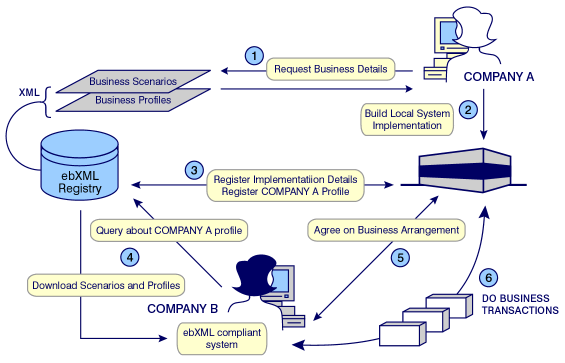 Based
on a review of the information available from an ebXML Registry,
Company A can build or buy an ebXML implementation suitable for its
anticipated ebXML transactions. The hope of the ebXML initiative is
that vendors will support all of the elements of ebXML. At such time,
an "ebXML system" might be little more than a prepackaged desktop
application. Or maybe, more realistically, the ebXML system will at
least be as manageable as a commercial database system (which still
needs a DBA). Figure 1 suggests that the hypothetical Company B uses something like this prepackaged application. Either
way, the next step is for Company A to create and register a CPP with
the Registry. Company A might wish to contribute new Business Processes
to the Registry, or simply reference available ones. The CPP will
contain the information necessary for a potential partner to determine
the business roles in which Company A is interested, and the type of
protocols it is willing to engage in for these roles. Once
Company A is registered, Company B can look at Company A's CPP to
determine that it is compatible with Company B's CPP and requirements.
At that point, Company B should be able to negotiate a CPA
automatically with Company A, based on the conformance of the CPPs,
plus agreement protocols, given as ebXML standards or recommendations. Finally,
the two companies begin actual transactions. These transactions are
likely to involve Business Messages conforming to further ebXML
standards and recommendations. At some point in all of this, however,
"real-world" activities will probably occur (for example, the shipment
of goods from one place to another, or the rendering of services).
ebXML will have helped in agreeing to, monitoring, and verifying these
real-world activities. Of course, in our "information economy," a lot
of what goes on might stay within the realm of ebXML -- maybe
everything within a particular business relationship. The Business Process Schema
The UN/CEFACT Modeling Methodology (UMM), which utilizes UML, may be
instrumental in modeling the ebXML Business Processes. However, such
modeling is simply a recommendation, not a requirement. In any case,
since this article targets XML developers and does not address OOD
(object-oriented design), it is more interesting herein to look at the
representation of the models in XML documents conformant to the
Business Process Specification DTD and XML Schema. The DTD (named
"ebXMLProcessSpecification- v1.00.dtd") appears, at this time, to be
the primary rule representation. Both this DTD and a W3C XML Schema,
which is (presumably) semantically and syntactically compatible, may be
found in the EbXML_BPschema_1.0 recommendation (seeResources). ebXML process specifications have a root element ProcessSpecification.
A particular process specification may contain subnode references to
other process specifications, as well as to document specifications and
other information. The DTD declaration for ProcessSpecification provides an overview of the structure of a Business Process document: Listing 1: ProcessSpecification DTD declaration
<!ELEMENT ProcessSpecification
          (Documentation*,
          (Include* | DocumentSpecification* |
            ProcessSpecification* | Package |
            BinaryCollaboration | BusinessTransaction |
            MultiPartyCollaboration)*)>
<!ATTLIST ProcessSpecification
          name    ID    #REQUIRED
          version CDATA #REQUIRED
          uuid    CDATA #REQUIRED >
|
The attribute uuid is a globally unique identifier for a process specification; the name and version are specific to the model represented (the name should not collide with nested process specifications). Within a process specification, a Package defines a set of collaborations that may be either MultiPartyCollaboration elements or BinaryCollaboration
elements. Collaborations, in turn, contain a variety of roles for the
parties. An excerpt from the sample process specification contained in
the EbXML_BPschema_1.0 recommendation (seeResources) is helpful in sorting out this structure: Listing 2: A package of collaborations
<Package name="Ordering">
  <!-- First the overall MultiParty Collaboration -->
  <MultiPartyCollaboration name="DropShip">
    <BusinessPartnerRole name="Customer">
      <Performs authorizedRole="requestor"/>
      <Performs authorizedRole="buyer"/>
      <Transition fromBusinessState="Catalog Request"
                  toBusinessState="Create Order"/>
    </BusinessPartnerRole>
    <BusinessPartnerRole name="Retailer">
      <Performs authorizedRole="provider"/>
      <Performs authorizedRole="seller"/>
      <Performs authorizedRole="Creditor"/>
      <Performs authorizedRole="buyer"/>
      <Performs authorizedRole="Payee"/>
[...]
  <BinaryCollaboration name="Request Catalog">
    <AuthorizedRole name="requestor"/>
    <AuthorizedRole name="provider"/>
    <BusinessTransactionActivity name="Catalog Request"
                                 businessTransaction="Catalog Request"
                                 fromAuthorizedRole="requestor"
                                 toAuthorizedRole="provider"/>
  </BinaryCollaboration>
[...]
|
Conclusion
The approval of ebXML specifications is moving along at a fairly rapid
pace (certainly for a standards organization). The draft specifications
were approved as version 1.0 recommendation in mid-May, 2001. I suspect
that it will take another year or two to shake out all of the issues
and details for such an ambitious vision. It appears, however, that
ebXML is on the way to widespread use a few years down the road. Now is
the time, therefore, for businesses to begin a serious consideration of
their own ebXML implementation plans. Resources - Find the sponsors of ebXML at: UN/CEFACT (United Nations Centre for Trade Facilitation and Electronic Business) and OASIS (Organization for the Advancement of Structured Information Standards).
- The ebXML initiative has produced a number of specifications. Find all of these specifications at
ebXML.org.
As specifications proceed through their approval process, their exact
URLs will change, so it is best simply to navigate via the ebXML
homepage. If later versions of the documents mentioned here are
produced, it will obviously make sense to refer to those superceding
versions:
- Find out more about SOAP messaging in an article by Bob DuCharme about building your own SOAP client and in the developerWorks XML messaging with SOAP tutorial.
- Uche Ogbuji covers ebXML and other matters relating to semantic transparency in his developerWorks column, Thinking XML. Check out the previous installments:
- R. A. Smith of IBM Research touches on how ebXML fits into the fabric of e-business infrastructure.
- Check out the IBM® WebSphere® Business Integration Zone and explore products for integrating data, applications, processes, and people.
- Look into David Mertz's previous installments of his XML Matters column. His most recent installment covers SQL queries via XML.
About the author
 The more David Mertz learns about business technologies, the more
firmly he is haunted by the spectre of Luddism. David may be reached at
mertz@gnosis.cx; his life pored over at
gnosis.cx/dW/. Suggestions and recommendations on this, past, or future articles are welcome.
The more David Mertz learns about business technologies, the more
firmly he is haunted by the spectre of Luddism. David may be reached at
mertz@gnosis.cx; his life pored over at
gnosis.cx/dW/. Suggestions and recommendations on this, past, or future articles are welcome. |
| |