|
|
 |
|
|
A new version of the site will be available soon!
|
|
|
|
 |
|
|
|
|
|
|
|
|
|
( 22.07.2004 )
|
|
|
|
( 22.07.2004 )
|
|
|
|
( 22.07.2004 )
|
|
|
|
( 21.07.2004 )
|
|
|
|
( 21.07.2004 )
|
|
|
|
( 15.07.2004 )
|
|
|
|
( 13.07.2004 )
|
|
|
|
( 05.07.2004 )
|
|
|
|
( 02.07.2004 )
|
|
|
|
( 02.07.2004 )
|
|
|
|
( 01.07.2004 )
|
|
|
|
( 01.07.2004 )
|
|
|
|
( 30.06.2004 )
|
|
|
|
( 27.06.2004 )
|
|
|
|
( 25.06.2004 )
|
|
|
|
( 24.06.2004 )
|
|
|
|
( 24.06.2004 )
|
|
|
|
( 24.06.2004 )
|
|
|
|
( 24.06.2004 )
|
|
|
|
( 23.06.2004 )
|
|
|
|
( 23.06.2004 )
|
|
|
|
( 17.06.2004 )
|
|
|
|
( 17.06.2004 )
|
|
|
|
|
|
|
|
|
UDDI and ebXML Registry: A Co-Existence Paradigm
|
|
 Top level
 Standards
UDDI
Standards
UDDI
|
|
Publishing date: 15.04.2003 10:10
|
| Joseph Chiusano, Senior Consultant with Booz Allen
Hamilton, describes how two prominent E-Business registry
specifications can co-exist and support different business needs. |
Universal Description, Discovery, and Integration
(UDDI) specification and the Electronic Business XML (ebXML) Registry
are the two most prominent types of e-business registries that
currently exist. There has existed a certain level of uncertainty among
those selecting an e-business registry (referred to as "registry
selectors") as to the main differences between the two specifications,
and which specification may be best for their specific needs. The
objective of this paper is to clarify the major focus of, and
differences between, each of these registry specifications, in an
effort to educate registry selectors and therefore enable them to make
the best choice possible. It is also intended to help implementers
understand the major differences between the two registry
specifications, especially within their information models.
We envision an environment in which there is a co-existence of
both UDDI registries and ebXML registries, and in which the strengths
and focus of each registry specification support its market presence
and primary usage. We do not foresee a merging of the two
specifications, as co-existence of both specifications is the best
possible scenario given their complementary strengths.
What is an E-Business Registry? An e-business registry is a
software product that acts as an organizing focal point for the wealth
of information and interactions that conducting e-business requires.
E-business registries serve various purposes, including:
-
Enabling the discovery of trading partners and their various capabilities
-
Classification, association of e-business artifacts such as XML
schemas, Document Type Definitions (DTDs), and trading partner profiles
-
Registration and discovery of Web service descriptions, such as Web Services Description Language (WSDL) documents
E-business registries are central to the execution of e-business
because they allow for the registration, management, and discovery of
those critical items that are crucial for the conduct of e-business.
The UDDI and ebXML registries are considered e-business registries,
each with a different primary focus.
History of the Specifications
UDDI The UDDI project began in October 2000 as a
collaboration between Microsoft, Ariba, and IBM. Its main goal was to
speed interoperability and adoption for Web services through the
creation of standards-based specifications for service description and
discovery, and the shared operation of a business registry on the Web.
Before the UDDI project, there was no industry-wide, accepted approach
for businesses to reach their customers and partners with information
about their products and Web services. UDDI enables enterprises to
quickly and dynamically discover and invoke Web services, both
internally (to the enterprise) and externally.
The initial idea behind UDDI was that software companies,
standards bodies, and programmers would populate the public "UDDI
Business Registry" with descriptions of different types of services,
while businesses would populate the registry with descriptions of the
services they support. Marketplaces, search engines, and business
applications would then query the registry to discover services at each
others' companies. Businesses would also use this data to facilitate
easier integration with each other over the Web. UDDI may also be
employed as a "private" registry (i.e. behind a firewall) that is
hosted by an e-marketplace, a standards body, or a consortium of
organizations that participate in a given industry.
UDDI was moved into the Organization for the Advancement of
Structured Information Standards (OASIS) in July 2002. The UDDI Version
2.0 and Version 3.0 specifications are both Technical
Committee-approved specifications. The Version 2.0 specification was
submitted for approval as an OASIS Open Standard in March 2003.
ebXML Registry The ebXML Registry specification was created
as part of the 18-month ebXML initiative that ended in May 2001.
Sponsored by the United Nations Centre for Trade Facilitation and
Electronic Business (UN/CEFACT) and OASIS, ebXML is a modular suite of
specifications that enables enterprises of any size and in any
geographical location to conduct business over the Internet. ebXML
provides companies with a standard method to exchange business
messages, conduct trading relationships, communicate data in common
terms and define and register business processes. An ebXML registry
provides a mechanism by which XML artifacts can be stored, maintained,
and automatically discovered, thereby increasing efficiency in
XML-related development efforts.
The OASIS/ebXML Registry Technical Committee was created in May
2001 to build on the ebXML initiative efforts. The ebXML Registry
Version 2.0 specification is an OASIS-approved specification, and the
ebXML Registry Version 3.0 specification is in the final phases of
development. The ebXML Registry specification is actually comprised of
2 specifications - ebXML Registry Information Model (ebRIM) and ebXML
Registry Services (ebRS). We refer to these specifications collectively
here as the "ebXML Registry specification".
ebXML Technical Architecture When considering ebXML Registry
in comparison to UDDI, it is necessary to view the ebXML Registry
within the context of the ebXML Technical Architecture. The ebXML
Registry is a central component of the ebXML Technical Architecture, as
it serves as a storage facility and discovery mechanism for the various
artifacts that are necessary for engaging in electronic business using
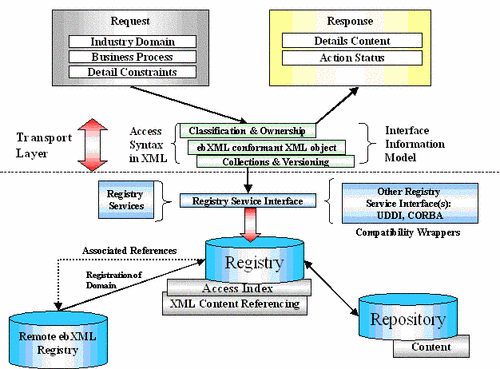
the ebXML framework. This is shown in the following figure:
|
|
Source: ebXML Technical Architecture Specification v1.04
|
In the figure above, an ebXML registry interacts
with both a local repository and a remote ebXML registry. Requests are
sent to the registry and responses are received from the registry
through a Registry Service Interface. The Registry Service Interface
may interact with other Registry Service Interfaces, such as UDDI, and
open interface standards such as Common Object Request Broker
Architecture (CORBA).
In addition to storing and managing XML artifacts, an ebXML
registry is also intended to store and manage various artifacts that
support business collaboration, in support of the ebXML framework.
Examples of such artifacts are:
- Collaboration Protocol Profile (CPP): Describes the
message-exchange capabilities of a Party involved in a business
collaboration; also used for trading partner discovery purposes.
- Collaboration Protocol Agreement (CPA): Defines the
capabilities that two Parties need to agree upon to enable them to
engage in a business collaboration.
- Business Process Specification Schema (BPSS): Provides
a standard framework by which business systems may be configured to
support the execution of business collaborations consisting of business
transactions.
Although the information models and underlying architectures of
the two registries are vastly different, there are distinct
similarities in the types of information that can be registered in
each. For example, both registries accommodate the registration of
business and Web services information. ebXML Registry, however, is
designed to accommodate additional types of content such as schemas,
DTDs, and XML documents.
Primary Focus of Each Registry In examining the primary focus
of each registry, we consider that there are two general ways in which
an e-business registry may be used: for discovery and for
collaboration. Both registries allow for discovery of businesses, their
Web services, and the technical interfaces they make available.
However, UDDI is focused exclusively on this discovery aspect, while
ebXML Registry is focused on both discovery and collaboration. We
believe that, due in large part to its strong branding, UDDI has a much
more prominent following than ebXML Registry for discovery of
businesses, their Web services, and the technical interfaces they make
available.
The primary focus of ebXML Registry extends beyond that of UDDI
into collaboration. This can be viewed on two levels: development
collaboration and run-time collaboration. Due to its focus on storing
and maintaining XML artifacts, an ebXML registry can enable both
collaborative development of XML artifacts within an organization and
run-time collaboration between trading partners. For example, users can
create XML artifacts and submit them to an ebXML registry for use and
potential enhancement by other users. Additionally, once trading
partners have discovered each other using the discovery mechanisms
defined as part of the ebXML framework (which involve CPPs and CPAs),
they can collaborate in data exchange scenarios using the XML artifacts
that are registered (and potentially stored) in the ebXML registry. The
parties can also conduct business scenarios according to discovered
business process specifications.
The ebXML Registry Technical Committee is in the process of
finalizing a "Best Practices" document for the registration of Web
services in an ebXML registry. We believe this document will help raise
awareness of the capabilities of registering Web services in an ebXML
registry.
Interoperability Between Registries There is the possibility
of run-time interoperability between UDDI and an ebXML registry in
terms of discovery. We will discuss below several papers that either
exist, or are in the process of being written, on this topic.
Using UDDI to find ebXML Registry/Repository In May 2001, IBM
and SUN authored a white paper titled "Using UDDI to find ebXML
Registry/Repository". This white paper presents a case study showing
how to use the UDDI Business Registry to search for an ebXML Registry,
and defines a series of steps that should be followed to define and
register an ebXML registry in a UDDI registry. This white paper can be
found at http://www.ebxml.org/specs/rrUDDI.pdf.
UDDI as the registry for ebXML Components The UDDI Technical
Committee is in the process of producing a Technical Note titled "UDDI
as the registry for ebXML components". This Technical Note provides
guidance on how to use UDDI registries within the ebXML framework of
B2B services, and how to enable automatic discovery of ebXML framework
components (Collaboration Protocol Profiles, Collaboration Protocol
Agreements, Business Process Schema Specifications, etc.) using UDDI.
This interoperability leverages the complementary strengths of each
registry in an effective manner.
Additional Possibilities There is also the possibility of
discovering an ebXML registry from within UDDI. However, no documents
have been produced on this topic to date by the OASIS/ebXML Registry TC.
While the interoperability between registries has been discussed from a
discovery standpoint, there does not currently exist a standard
mechanism for interoperability on an information exchange level. That
is, there does not currently exist a standard mechanism for seamlessly
transferring information between a UDDI registry and an ebXML registry.
Additionally, there does not currently exist a standard mechanism for
querying both types of registries at an abstract level - that is, in
which information can be pulled from either a UDDI registry or ebXML
registry using the same query mechanism on both types of registries.
What the Future Holds We envision an environment in which
there is a co-existence of both UDDI registries and ebXML registries,
and in which the strengths of each specification support its market
presence. We believe that the focus of the UDDI specification on
discovery of businesses, their Web services, and the technical
interfaces they make available, will enable UDDI to continue to be the
most prominent e-business registry specification for discovery
purposes. We believe that the strength of ebXML Registry for support of
both discovery and collaboration will enable ebXML Registry to continue
to be the most prominent e-business registry for collaboration - which
first requires discovery. We also believe that the capability of ebXML
Registry to register Web service definitions is a necessary feature, as
much business collaboration will take place using Web services.
Version 3.0 of both specifications have brought the two registries
closer than ever in terms of features. This is largely due to market
forces that drive the existence of certain features (such as digital
signature support), and we foresee this continuing in the future. We
also believe that registry selectors should primarily base their
decisions on the main focus and strength of each registry (as discussed
above) rather than on specific features. A feature that is considered
"missing" from one registry specification (because it appears in the
other) may very well appear in a later version of that registry
specification.
We do not foresee a merging of the two specifications, as
co-existence of both specifications is the best possible scenario given
their complementary strengths. However, a greater level of
collaboration between the two technical committees will likely occur in
the future, in ways that will enable increased interoperability between
the two registries.
About the Author Joseph Chiusano is a Senior Consultant with
Booz Allen Hamilton's IT Digital Strategies Team. His XML expertise
includes XML schema, Web services, digital security, XML registries,
and XML vocabularies. His general technology experience includes such
diverse areas as systems architecture, relational database applications
design and development, and operating system development.
References - ebXML Registry Information Model Specification v3.0 (public release pending)
- ebXML Registry Services Specification v3.0 (public release pending)
- ebXML Technical Architecture Specification v1.04: http://www.ebxml.org
- UDDI Version 3.0 specification, July 2002: http://uddi.org
- "The role of private UDDI nodes in Web services, Part 1: Six species
of UDDI" by Steven Graham, May 2001, IBM developerWorks: http://www-106.ibm.com/developerworks
About Booz Allen Hamilton Booz Allen Hamilton has been at the
forefront of management consulting for businesses and governments for
more than 80 years. Booz Allen combines strategy with technology and
insight with action, working with clients to deliver results today that
endure tomorrow. With 11,000 employees on six continents, the firm
provides services in strategy, organization, operations, systems, and
technology to the world's leading corporations, government and other
public agencies, emerging growth companies, and institutions.
For more information about this article, or for information about
Booz Allen's XML and Web Services capabilities, contact Terry Bjornsen
at 703.377.4157 or bjornsen_terence@bah.com, or Joseph Chiusano at
703.902.6923 or chiusano_joseph@bah.com.
|
|
|
|