
by Dr. Jim Webber & Dr. Mark Little
In July 2002, BEA, IBM, and Microsoft released a trio of specifications designed to support business transactions over Web services. These specifications - BPEL4WS, WS-Transaction, and WS-Coordination - together form the bedrock for reliably choreographing Web services-based applications, providing business process management, transactional integrity, and generic coordination facilities respectively.
This article introduces the underlying concepts of Web Services Coordination, and shows how a generic coordination framework can be used to provide the foundations for higher-level business processes. In future articles, we will demonstrate how coordination allows us to move up the Web services stack to encompass WS-Transaction and on to BPEL4WS.
Coordination
In general terms, coordination is the act of one entity (known as the
coordinator) disseminating information to a number of participants for
some domain-specific reason. This reason could be in order to reach
consensus on a decision like a distributed transaction protocol, or
simply to guarantee that all participants obtain a specific message, as
occurs in a reliable multicast environment. When parties are being
coordinated, information known as the coordination context is
propagated to tie together operations that are logically part of the
same coordinated work or activity. This context information may flow
with normal application messages, or may be an explicit part of a
message exchange and is specific to the type of coordination being
performed. For example, a security coordination service will propagate
differently formed contexts than a transaction coordinator.
Despite the fact that there are many types of distributed applications that require coordination, it will be no surprise to learn that each domain typically uses a different coordination protocol. In transactions, for example, OASIS Business Transactions Protocol and Object Management Group's Object Transaction Service are solutions to specific problem domains that are not applicable to others since they are based on different architectural styles.
Given the domain-specific nature of these protocols (i.e., loosely coupled transactional Web services and tightly coupled transactional CORBA objects) there is no way to provide a universal solution without jeopardizing efficiency and scalability in each individual domain; and not everyone wants to (or can afford to) have a full-blown transaction processing system in order to do coordination. However, both of these protocols have the underlying requirement for propagating contextual information to participants, and therefore it would make some sense if that mechanism could be made generic, and thus reused. On closer examination, we find that even solely within the Web services domain we encounter situations where coordination is a requirement of several different types of problem domain, such as workflow management and transaction processing, but where the overall models are very different yet that same requirement for coordination is still present.
WS-Coordination
The fundamental idea underpinning WS-Coordination is that there is
indeed a generic need for propagating context information in a Web
services environment, which is a shared requirement irrespective of the
applications being executed. The WS-Coordination specification defines
a framework that allows different coordination protocols to be plugged
in to coordinate work between clients, services, and participants (see
Figure 1). The WS-Coordination specification talks in terms of
activities, which are distributed units of work involving one or more
parties (which may be services, components, or even objects). At this
level, an activity is minimally specified and is simply created, made
to run, and then completed.
In Figure 1, we suggest that the framework is useful for propagating
security, workflow, or replication contexts, though this is by no means
an exhaustive list. Nonetheless, whatever coordination protocol is
used, and in whatever domain it is deployed, the same generic
requirements are present:
The first three points are directly the concern of
WS-Coordination, while the fourth is the responsibility of a
third-party entity, usually the client application that controls the
application as a whole. These four roles and their interrelationships
are shown in Figure 2. Activation
Registration When a participant is registered with a
coordinator through the registration service, it receives messages that
the coordinator sends (for example, "prepare to complete" and
"complete" messages if a two-phase protocol is used); where the
coordinator's protocol supports it, participants can also send messages
back to the coordinator.
Completion
Context
While the first three points are common sense, the fourth is
somewhat more interesting. Since WS-Coordination is generic, it is of
very little use to applications without augmentation, and this is
reflected in the part of the WS-Coordination XML schema for contexts.
In Listing 3, the schema states that a context consists of a URI that
uniquely identifies the type of coordination that is required
(xs:anyURI), an endpoint where participants to be coordinated can be
registered (wsu:PortReferenceType), and an extensibility element
designed to carry specific coordination protocol context payload
(xs:any), which can carry arbitrary XML payload. (Note: This type also
inherits some useful features from its parent in the form of a
time-to-live value and an identifier.) Coordinating Business Processes on the Web
Here we see the initial stages of the application. The client
application locates an activation service and sends it a message asking
for the creation of a security coordinator and a corresponding security
context, passing appropriate user credentials as part of the activation
process as shown in Listing 4. Assuming that a security
coordination service has been registered with the coordination
framework, a coordinator is created (and exposed as a registration
service) and a context like that in Listing 4 is duly returned to the
client application as part of the CreateCoordinationContextResponse
message. The client application interacts with its component
Web services sending and receiving messages as normal, with the
exception that it embeds the coordination context (which carries the
security information) in a SOAP header block in its messages to provide
authenticity credentials for those services that are invoked.
Let's assume that a service understands the protocol messages
associated with our simple centralized sign-on service, and furthermore
hasn't registered a participant previously. Once the service receives a
SOAP message containing a security context header (see Listing 5), it
registers a participant with the coordinator using the details provided
in the context (via the WS-Coordination registration service URI, for
example). This registration operation occurs every time a service
receives a particular context for the first time, which ensures that
all services register participants within the activity. When
the client decides to terminate its session and log out of the services
it has been using, it sends a completion message to the coordinator; in
turn, the coordinator informs each registered participant to revoke the
privileges for the client application, preventing it from using their
corresponding services. Any subsequent calls by the client to that
service with the same context will result in the service being unable
to register a participant since the context details will no longer
resolve to a live coordinator to register with (see Figure 4).
At some point, the client application finishes its work and must run
the completion protocol to force its own system-wide logoff. To do
this, it sends a security protocol logoff message to the security
coordinator. This message is entirely out-of-scope of WS-Coordination
and is instead defined by the specification of our security protocol
which plugs in to the WS-Coordination framework. The completion message
is shown in Listing 6. In response to receiving this message,
the security coordinator informs each of its registered participants to
terminate the user's current session. To do this, it sends each of the
participants a signOut message to which they respond with a signedOut
message, confirming that the user is no longer authenticated with that
particular participant's associated service. The pertinent parts of the
signOut and signedOut messages are shown in Listing 7. Once a
signedOut message has been received from each of the enrolled
participants, it can report back to the client application that its
session has been ended. The final message in our WS-Coordination
protocol is the loggedOut response message from the security
coordination to the client (see Listing 8).
Advanced Usage Scenarios
Interposition is a way of creating a hierarchy of coordinators, each of
which looks like a simple participant to coordinators higher up the
coordination tree, yet acts just like a normal coordinator for
participants lower down the tree. Coordinators become registered within
this hierarchy if the client application sends a CreateCoordination
Context message to an activation service along with a valid context.
When the receiving activation service creates the new context (and
associated coordinator/registration service), it uses the original
context to determine the endpoint of its superior coordinator (a.k.a.
registration service) and enrolls the new coordinator with it.
In Figure 5 we see a typical interposed coordinator arrangement
spanning three different enterprises using two different coordination
protocols. This arrangement is arrived at through a client application
creating a top-level context and then invoking Web services within the
bounds of its partner enterprises. In the noninterposed case, upon
first receipt of a context embedded in a SOAP header a service
registers a participant with the coordinator identified by the context.
However, in this situation, for reasons such as security or
trustworthiness, the service enrolls its own coordinator by sending an
activation message loaded with the top-level context to a local
activation service, and then registers with the newly created local
coordinator. (Note: By using ts own coordinator, the service
or domain in which it resides only exposes the coordinator to the
superior and not the individual participants. This may be useful in
restricting the amount of information that can flow out of the domain
and hence be available to potentially upotentially unsecure or
untrusted individuals/services.)
Having received a context with an activation message, the newly created
coordinator duly registers itself with the registration service that
the context advertises. The top-level coordinator is unaware of this
arrangement since it sees the interposed coordinator as a participant,
while the local participants are coordinated by their own local
coordinator, which confers the following advantages:
In Figure 5 Enterprise A uses the same coordination protocol as
the top-level coordinator. In this case, Enterprise A's coordinator
coordinates local participants according to the same protocol as the
top-level. However, since only the outcome of the local coordination
needs to be sent over the Internet to the top-level coordinator, and
not the more abundant coordination protocol messages, this approach is
performance-optimized, compared to registering Enterprise A's
participants directly with the top-level coordinator. For
Enterprise B and Enterprise C, the same performance benefit exists,
although the real focus of coordinating these participants is the fact
that they are coordinated with different protocols that suit the
particular enterprise's needs and not necessarily the same coordination
protocol used at the top level. Since the local coordinator for each
enterprise is effectively "bilingual" in the coordination protocols
they understand (knowing both the participant aspects of the top-level
coordination protocol and the coordinator aspects of their own internal
coordination protocols), different coordination domains can easily be
bridged without adding complexity to the overall architecture.
Summary Though WS-Coordination is
generically useful, at the time of this writing only one protocol that
leverages WS-Coordination has been made public: WS-Transaction We'll
look at this protocol in our next article.
Author Bio
Dr. Jim Webber is an architect and Web services fanatic at
Arjuna Technologies where he works on Web services transactioning and
Grid computing technology. Prior to joining Arjuna Technologies, he was
the lead developer with Hewlett-Packard working on their BTP-based Web
Services Transactions product - the industry's first Web Services
Transaction solution. An active speaker and Web Services proponent, Jim
is the coauthor of "Developing Enterprise Web Services."
Listing 1: Activation Service WSDL Interfaces
Where is Sun Microsystems?
It seems great that BEA, Microsoft and IBM are all making millions $$$
on WS-coordination effort to make their platform, software compatible.
But what about Sun? What kind of role it plays? After all, Java is the
thread for all of these efforts. Sun should play more active role in
Web Server and Web Services market by jumping onto the bandwaggon!
I think Microsoft might have a few things to say about "Java is the
thread ..." since their offerings won't be Java based ;-) I don't have
any insights I can share as to what Sun is doing in this area, but
there's obviously a lot going on in the Java space, what with J2EE and
JCP, and there has been a lot of effort over the last year on Web
Services in J2EE. So, maybe it's just a matter of timing?
We tend to equate Java = Sun. Today, my believe is not so. IBM &
others are very deep into Java as well. Moreover, WS is not about Java.
WS is independent of tools.
Hi, I working in my Tesis, and need information of analyst and design of webservices.
The WS-Coordination framework exposes an Activation Service that
supports the creation of coordinators for specific protocols and their
associated contexts. The process of invoking an activation service is
done asynchronously, so the specification defines both the interface of
the activation service itself, and that of the invoking service, so
that the activation service can call back to deliver the results of the
activation - namely a context that identifies the protocol type and
coordinator location. These interfaces are presented in Listing 1,
where the activation service has a one-way operation that expects to
receive a CreateCoordinationContext message, and correspondingly the
service that sent the CreateCoordinationContext message expects to be
called back with a CreateCoordination ContextResponse message, or
informed of a problem via an Error message.
Once a coordinator has been
instantiated and a corresponding context created by the activation
service, a Registration Service is created and exposed. This service
allows participants to register to receive protocol messages associated
with a particular coordinator. Like the activation service, the
registration service assumes asynchronous communication and so
specifies WSDL for both registration service and registration requester
(see Listing 2).
The role of terminator is
generally played by the client application, which at an appropriate
point will ask the coordinator to perform its particular coordination
function with any registered participants - to drive the protocol
through to its completion. On completion, the client application may be
informed of an outcome for the activity, which may vary from simple
succeeded/ failed notification through to complex structured data
detailing the activity's status.
The context is critical to
coordination since it contains the information necessary for services
to participate in the protocol. It provides the glue to bind all of the
application's constituent Web services together into a single
coordinated application whole. Since WS-Coordination is a generic
coordination framework, contexts have to be tailored to meet the needs
of specific coordination protocols that are plugged into the framework.
The format of a WS-Coordination context is specifically designed to be
third-party extensible and its contents are as follows:
To show WS-Coordination in action, we'll consider a centralized sign-on
service that enables a client application to authenticate once, and
then use given credentials to access a number of Web services, and to
de-authenticate from the system with a single operation irrespective of
the number of Web services that are invoked. (Note: It's
important to note that although the coordination strategy outlined here
is reasonable enough, the patter as a whole isn't industrial strength
since we avoid clouding the coordination issues by drawing on other
useful technologies such as XML encryption and XML signature, which a
truly trustworthy implementation would utilize. You should remember
while following this example through that a real implementation would
draw heavily on security standards like XML-encryption to provide the
necessary privacy and XML digital signatures to provide authenticity.)
The initial coordination pattern for this scenario is captured in
Figure 3.
In our security coordination example, the overall architecture is
relatively static and known in advance of the coordination. However, it
may be that in a business-to-business scenario we would like the
ability to coordinate arbitrary groups of Web services as part of a
single, logical, coordinated application. WS-Coordination supports this
through a scheme known as interposition.
WS-Coordination looks set to become the adopted standard for activity
coordination on the Web. Out of the box, WS-Coordination provides only
activity and registration services, and is extended through protocol
plug-ins that provide domain-specific coordination facilities. In
addition to its generic nature, the WS-Coordination model also scales
efficiently via interposed coordination, which allows arbitrary
collections of Web services to coordinate their operation in a
straightforward and scalable manner.
Dr. Mark Little is chief architect, transactions, for Arjuna
Technologies Limited, a spin-off from Hewlett-Packard that develops
transaction technologies for J2EE and Web services. Previously, Mark
was a distinguished engineer and architect at HP Middleware, where he
led the transactions teams. He is a member of the expert group for JSR
95, and JSR 117, is the specification lead for JSR 156, and is active
on the OTS Revision Task Force and the OASIS Business Transactions
Protocol specification. Mark is the coauthor of J2EE 1.4 Bible and Java
Transactions for Architects.
Jim.Webber@arjuna.com
Source Code
message="wscoor:CreateCoordinationContext"/>
name="CreateCoordinationContextResponse">
message="wscoor:CreateCoordinationContextResponse"/>
Listing 2: Registration Service WSDL Interface
Listing 3: WS-Coordination Context Schema Fragment
abstract="false">
type="xs:anyURI" />
type="wsu:PortReferenceType" />
minOccurs="0" maxOccurs="unbounded" />
Listing 4: Security Coordination Activation Message
xmlns:soap="http://www.w3.org/2002/06/soap-envelope">
xmlns="http://schemas.xmlsoap.org/ws/2002/08/wscoor"
xmlns:wsu="http://schemas.xmlsoap.org/ws/2002/07/utility"
xmlns:security="http://security.example.org/authentication">
http://activation.example.org
a.n@other.com
foobar
http://workstation.example.org/station101
http://security.example.org/single-logon
Listing 5: A Security Context
xmlns:soap="http://www.w3.org/2002/06/soap-envelope">
xmlns="http://schemas.xmlsoap.org/ws/2002/08/wscoor"
xmlns:wsu="http://schemas.xmlsoap.org/ws/2002/07/utility"
xmlns:security="http://security.example.org/authentication">
http://workstation.example.org/station101
http://security.example.org/single-logon
http://security.example.org/registration
1234-5678-9ABC-DEF0
Listing 6 Security Protocol Completion Request Message
xmlns:soap="http://www.w3.org/2002/06/soap-envelope"
xmlns:wscoor="http://schemas.xmlsoap.org/ws/2002/08/wscoor"
xmlns:wsu="http://schemas.xmlsoap.org/ws/2002/07/utility"
xmlns:sec="http://security.example.org/authentication"
xmlns:comp="http://security.example.org/authentication/
completion">
http://workstation.example.org/station101
a.n@other.com
foobar
Listing 7 signOut and signedOut Message Contents
http://security.example.org/logout-service
a.n@other.com
http://printer.example.org/logout-service
a.n@other.com
Listing 8 The loggedOut Message indicates session termination
xmlns:soap="http://www.w3.org/2002/06/soap-envelope"
xmlns:wscoor="http://schemas.xmlsoap.org/ws/2002/08/wscoor"
xmlns:wsu="http://schemas.xmlsoap.org/ws/2002/07/utility"
xmlns:sec="http://security.example.org/authentication"
xmlns:comp="http://security.example.org/authentication/
completion">
http://security.example.org/authentication
a.n@other.com
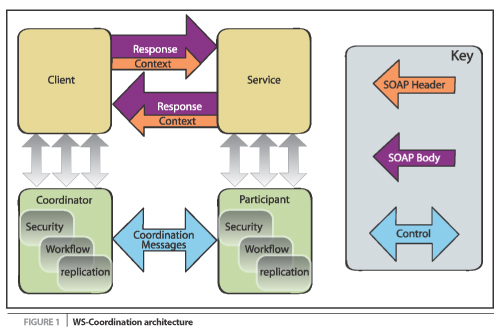
Figure 1
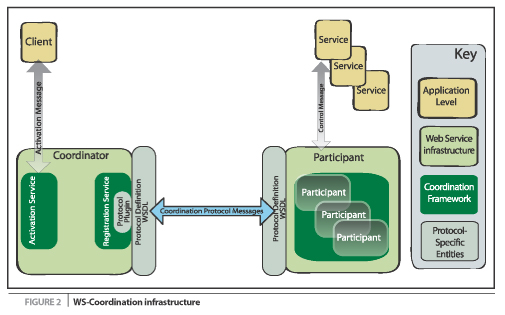
Figure 2
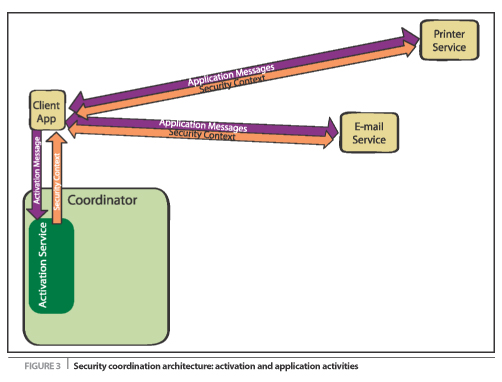
Figure 3
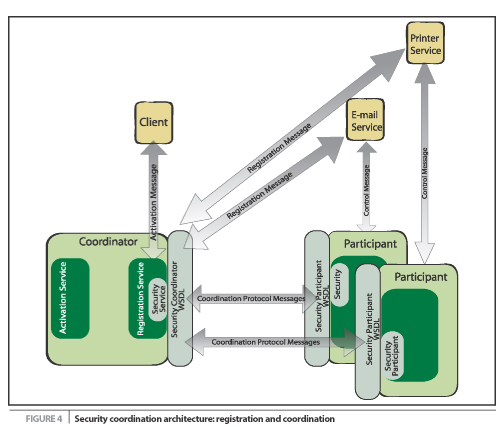
Figure 4
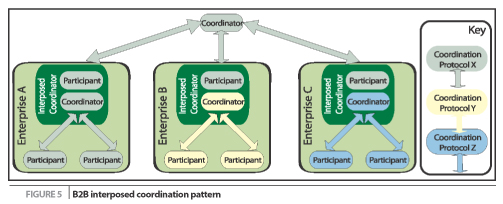
Figure 5
Reader Feedback
Posted by Donald Hsu on May 6 @ 06:13 AM
Where is Sun?
Posted by Mark Little on May 7 @ 04:54 AM
Mark.
Where is Sun?
Posted by Sei ES on Jun 9 @ 09:28 PM
Help
Posted by peter on Apr 5 @ 12:19 PM
please help me!!
thank you.